|
|
| 第2行: |
第2行: |
| [[File:Assimilation.jpg|430px|thumb|right|Duchies from the kingdom of Aquitaine drifting into the kingdom of France in 1066.]] | | [[File:Assimilation.jpg|430px|thumb|right|Duchies from the kingdom of Aquitaine drifting into the kingdom of France in 1066.]] |
|
| |
|
| [[File:Alert de jure.png]] '''De jure''' is a Latin expression which literally means "by law". It is contrasted with ''de facto'', which means "in fact". ''De jure'' ownership of land and titles is an important concept in the game as it determines AI behavior and the ability of the player to declare war. | | [[File:Alert de jure.png]] '''De jure''' 是一个拉丁语单词,意思是“法理”。它的反义词是de fact ,意思是“实际上”。土地和头衔的法理所有权是游戏中的一个重要概念,因为它决定了AI的行为和玩家能否宣战。 |
|
| |
|
| Each duchy, kingdom and empire has a legal right to a land area in the game. If one ruler has occupied land that rightfully belongs to another, then they will have a ''de jure'' [[casus belli]] on that land area. For counties, the count holding the county title is the ''de jure'' liege of all holdings within the province.
| | 每个公国、王国和帝国都对游戏中的土地区域拥有合法权利。如果一个统治者占领了理应属于另一个统治者的土地,那么他们将在该土地区域上拥有法理上的[[casus belli|宣战理由]] 。对于伯爵,持有伯爵头衔的伯爵是该省内所有财产的法理领主。 |
|
| |
|
| AI characters, including vassals to the player, will be upset if the liege hold land that ''de jure'' belongs to them. E.g., if they hold a duke-rank title and the player holds one of their ''de jure'' counties. Each instance of this produces a negative opinion modifier which stacks without limit. The player's own vassals will also be upset if they are not the liege of vassals that ''de jure'' fall under their dominion, e.g. a baron in one of their counties calls the player their liege instead of them. They will be pleased if these vassals are transfered to them. In general, all rulers in the game will believe they are fully entitled to whatever traditionally belongs to them and they will wage war to get their way if they think they can win. | | AI 角色,包括玩家的封臣,如果领主拥有法理上属于他们的土地,他们会感到不安。例如,如果某人拥有公爵头衔,而玩家拥有他的法理伯爵领之一。每个不符合法理的领地产权从属都会产生一个负面意见修正,该修正可以无限制地叠加。 |
|
| |
|
| The ''de jure'' ruler of a Kingdom or Empire also decides the [[Crown Authority]] of the realm. ''De facto'' owners of parts of a ''de jure'' realm are then granted voting rights for laws if the rulers are of the same religion. With the [[File:DLC icon Conclave.png]] [[Conclave]] DLC, this feature is replaced by [[council]] votes instead.
| | 如果玩家自己附庸中(二级附庸)存在不属于自己法理的“三级附庸”,二级附庸们也会感到不安,例如,某个伯爵领的领主非他们的法理公爵而是玩家,此时,如果玩家转移封臣到了法理的二级附庸中,二级附庸就会很高兴。 |
|
| |
|
| Titles with [[feudal elective]] succession have all their ''de jure'' vassal rulers of the same religion as nominators.
| | 一般来说,游戏中的所有统治者都认为他们完全有权获得传统上属于他们的任何东西,如果他们认为自己能赢,他们就会发动战争来达到自己的目的。 |
|
| |
|
| ==De jure drift==
| | 王国或帝国的法理统治者也决定该王国的王权法。如果统治者属于同一宗教,则法理上的实际所有者将被授予法律的投票权。在[[File:DLC icon Conclave.png]] [[Crown Authority|御前会议]]DLC中,此功能被议会投票取代。 |
| '''De jure drift''' or '''assimilation''' is the process by which the ''de jure'' borders of [[kingdoms]] and [[empires]] can change over time.
| |
|
| |
|
| In general, a duchy will assimilate into a kingdom after being controlled by that kingdom for 100 years (depending on game rules set at start), and a kingdom will similarly assimilate into an empire in the same time frame. Every [[duchy]] in the game is considered to be part of a specific de jure kingdom. Vassals within a de jure border have less reasons and abilities to revolt against their liege and declare independence. Both the duration required for assimilation and any additional conditions required can be changed at the [[game rules]].
| | [[feudal elective]] 封建选举继承的头衔由同一宗教的所有法理封臣统治者作为提名人。 |
|
| |
|
| A duchy will begin to drift into a kingdom when the following conditions are met:
| |
| * The entire duchy (i.e. all county titles; baronies are allowed to be outside the realm) is within the realm of the king.
| |
| * The king does not hold the crown of the current de jure kingdom to which the duchy belongs.
| |
| * The ducal title either does not exist or is held by the king or by a vassal of the king.
| |
| * The duchy is not part of the kingdom of Jerusalem.
| |
| * The kingdom is its owner's [[primary title]].
| |
|
| |
|
| Upon reaching Jan 01 of the next year, drift is visible as dashed stripes on the kingdoms [[map mode]]. Hovering over the duchy will show a tooltip indicating the number of years until full assimilation.
| |
|
| |
|
| Whenever the conditions for assimilation are not met — for example, if the local ruler of a duchy rebels against top-liege, or if one of the counties in the duchy is conquered by another independent realm - the counter will tick backwards instead of forwards, and at twice the speed. When the conditions are again met — for example, if the duke's rebellion is put down - the counter will resume ticking forwards.
| |
|
| |
|
| Kingdoms assimilate into empires in a near-identical fashion: The emperor must hold or control all county titles in the ''de jure'' kingdom, and the empire title to which the kingdom belongs ''de jure'' either does not exist or is not held by that emperor. In addition, however, all duchy titles that are ''de jure'' vassals of the kingdom must be either under the emperor's control or not held at all.
| | ==法理转移== |
| | 法理转移或法理同化是[[kingdoms|王国]]和[[empires|帝国]]国的法理边界随时间变化的过程。 |
|
| |
|
| Assimilation allows [[Titular Title|titular]] kingdoms and empires to become non-titular and vice versa. If a ''de jure'' kingdom becomes titular, it can be created by whoever controls its ''de jure'' capital.
| | 一般来说,一个公国在被该王国控制 100 年后(取决于开始时设定的游戏规则)会同化为一个王国,一个王国也会在同一时间范围内被一个帝国同化。游戏中的每个[[duchy| 公国]] 都被视为特定法理王国的一部分。法理边界内的封臣没有太多理由和能力反抗他们的领主并宣布独立。同化所需的持续时间和所需的任何其他条件都可以在[[game rules|游戏规则]]中更改。 |
|
| |
|
| ==Analysis== | | 当满足以下条件时,公国将开始法理转移到另一个王国: |
| Assimilation can be both good and bad from a gameplay perspective:
| | |
| * An assimilated duke (or king) becomes more loyal, can vote in elections (which may not be a good thing; see below), and provides more levies. | | 1.整个公国(即所有伯爵领头衔,且男爵领在王国之外)都在领土内。 |
| **In most instances, this increase in levies due to successful ''de jure'' shift is about 40%. But, if a duchy shifts from outside a king's ''de jure'' empire into the kingdom, the increase in levies is 100%, with all other factors remaining the same. | | |
| * But, the assimilated duchy no longer counts towards the total territories needed to claim a crown. E.g. as the King of Scotland, you control the Duchy of Ulster in northern Ireland. Before the duchy assimilates, the player would control 4 out of 13 counties in Ireland and only needs 3 more to be proclaimed king of Ireland. But if Ulster assimilates into Scotland, the player will now have 0 out of 9 counties in Ireland and needs to conquer 5 more to become king of Ireland. | | 2.国王不持有公国所属的当前法理王国的王冠。 |
| * If the kingdom's (or empire's) succession law is set to feudal elective, an assimilated duchy will add an additional elector in deciding the heir to the kingdom (or in the case of an assimilated kingdom, usually several electors for the empire's heir), adding some uncertainty to the succession. This becomes more problematic with {{icon|con}}Conclave, especially for feudal realms which adopted feudal elective by passing the "full council authority" law, as the realm cannot switch ''from'' feudal elective as long as the law stands. | | |
| | 3.公爵头衔要么不存在,要么由国王或国王的附庸持有。 |
| | |
| | 4.公国不是耶路撒冷王国的一部分。 |
| | |
| | 5.王国是其所有者的[[primary title|主要头衔]]。 |
| | |
| | |
| | 到达第二年 1 月 1 日后,正在法理转移的王国[[map mode|地图模式]]中显示为虚线条纹。将鼠标悬停在公国上会显示一个提示,指示距离完全同化的年数。 |
| | |
| | 每当没有满足同化的条件时——例如,如果一个公国的地方统治者反抗最高领主,或者如果公国的一个伯爵领被另一个独立王国征服——计时器就会减少而不是增加,计时器的减少速度是增加的两倍。当条件再次满足时——例如,如果公爵的叛乱被平息,计时器将继续增加。 |
| | |
| | 王国以几乎相同的方式同化为帝国。皇帝必须持有或控制法理王国中的所有伯爵领头衔,而该王国在法理上属于的帝国头衔要么不存在,要么不由该皇帝持有。然而,此外,所有在法律上是王国附庸的公国头衔必须由皇帝控制或无人持有。 |
| | |
| | 同化允许[[Titular Title|名誉头衔]]的王国和帝国变成一个拥有法理封臣的头衔,反之亦然。如果一个法理王国成为荣誉头衔的王国,那个消失的法理王国可以由控制其法理首都的人创建。 |
| | |
| | == 分析== |
| | 从游戏性的角度来看,法理同化既有好有坏: |
| | * 被同化的头衔公爵(或国王)变得更加忠诚,可以在选举中投票(这可能不是一件好事,见下文),并提供更多的征税。 |
| | ** 在大多数情况下,由于成功的法理转移而导致的征税增加约为40% 。但是,如果一个公国从国王的法理帝国之外转移到王国,征税的增加是 100% ,所有其他因素保持不变。 |
| | * 但是,被同化的公国不再计入宣称王国所需的总领土数。例如,作为苏格兰国王,您控制着北爱尔兰的阿尔斯特公国。在公国被同化之前,玩家将控制爱尔兰王国13个伯爵领中的4个,只需要再控制 3个伯爵领就被宣布为爱尔兰国王(7/13 大于50%)。但是,如果阿尔斯特被苏格兰同化,玩家现在将拥有爱尔兰王国下9个伯爵领中的0个,需要再征服5个伯爵领(5/9 大于50%)才能成为爱尔兰国王。 |
| | * 如果王国(或帝国)的继承法设置为封建选举法,则被同化的公国将在决定王国的继承人时增加一名额外的投票人(或者在被同化的王国的情况下,通常为帝国的继承人增加几个选帝侯),从而为继承增加一些不确定性。这在拥有 {{icon|con}} 御前会议DLC时会变得更加有问题,特别是对于通过“完全议会权力”法律采用封建选举制的封建王国来说,因为只要法律有效,该法理上的王权继承法就不能从封建选举制转换为其他继承法。 |
|
| |
|
| ==实际== | | ==实际== |
| Despite the importance of the ''de jure'' concept, depending on your circumstances, you might have to pay more attention to the ''de facto'' situation.
| | 尽管法理概念很重要,但根据玩家的真实情况,您可能需要注意以下几点。 |
| *[[Liege tax]] is not affected by ''de jure'' modifiers; merchant republics should expand with the intention of creating more republic vassals for income, rather than feudal vassals for levies. | | *[[Liege tax|领主税]] 不受法理修正的影响。商业共和国扩张时,应当创造更多的共和国附庸国来获得更多收入,而不是建立封建附庸国,这样的征税收入会变少。 |
| *Under [[Tanistry]] succession, electors are ''de facto'' vassals. | | * 在[[Tanistry|凯尔特选任法]] 下,选帝侯实际上是附庸。 |
| *{{icon|hl}}[[Nomadic]] and [[tribal]] rulers call their clans and direct tribal vassals respectively, to war as allies, rather than provide liege [[levies]]. | | *{{icon|hl}}[[Nomadic|游牧制]] 和[[tribal|部落制]] 的统治者将会在战争时直接召唤封臣作为盟友,而不是通过领主[[levies|征兵]] 的方式征用封臣的部队。 |
| [[Category:领地]] | | [[Category:领地]] |
| {{RealmNavbox}} | | {{RealmNavbox}} |
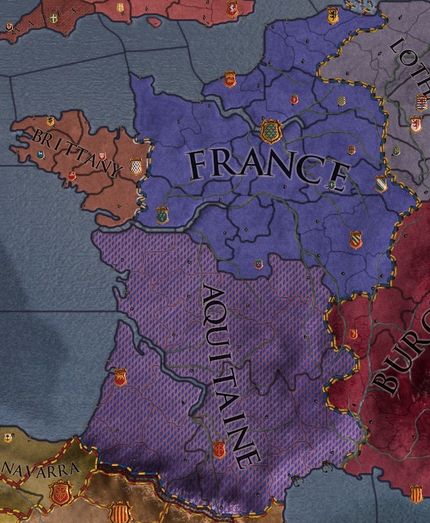
Duchies from the kingdom of Aquitaine drifting into the kingdom of France in 1066.
 De jure是一个拉丁语单词,意思是“法理”。它的反义词是de fact,意思是“实际上”。土地和头衔的法理所有权是游戏中的一个重要概念,因为它决定了AI的行为和玩家能否宣战。
每个公国、王国和帝国都对游戏中的土地区域拥有合法权利。如果一个统治者占领了理应属于另一个统治者的土地,那么他们将在该土地区域上拥有法理上的宣战理由。对于伯爵,持有伯爵头衔的伯爵是该省内所有财产的法理领主。
AI 角色,包括玩家的封臣,如果领主拥有法理上属于他们的土地,他们会感到不安。例如,如果某人拥有公爵头衔,而玩家拥有他的法理伯爵领之一。每个不符合法理的领地产权从属都会产生一个负面意见修正,该修正可以无限制地叠加。
如果玩家自己附庸中(二级附庸)存在不属于自己法理的“三级附庸”,二级附庸们也会感到不安,例如,某个伯爵领的领主非他们的法理公爵而是玩家,此时,如果玩家转移封臣到了法理的二级附庸中,二级附庸就会很高兴。
一般来说,游戏中的所有统治者都认为他们完全有权获得传统上属于他们的任何东西,如果他们认为自己能赢,他们就会发动战争来达到自己的目的。
王国或帝国的法理统治者也决定该王国的王权法。如果统治者属于同一宗教,则法理上的实际所有者将被授予法律的投票权。在 御前会议DLC中,此功能被议会投票取代。
feudal elective封建选举继承的头衔由同一宗教的所有法理封臣统治者作为提名人。
法理转移
法理转移或法理同化是王国和帝国国的法理边界随时间变化的过程。
一般来说,一个公国在被该王国控制 100 年后(取决于开始时设定的游戏规则)会同化为一个王国,一个王国也会在同一时间范围内被一个帝国同化。游戏中的每个公国都被视为特定法理王国的一部分。法理边界内的封臣没有太多理由和能力反抗他们的领主并宣布独立。同化所需的持续时间和所需的任何其他条件都可以在游戏规则中更改。
当满足以下条件时,公国将开始法理转移到另一个王国:
1.整个公国(即所有伯爵领头衔,且男爵领在王国之外)都在领土内。
2.国王不持有公国所属的当前法理王国的王冠。
3.公爵头衔要么不存在,要么由国王或国王的附庸持有。
4.公国不是耶路撒冷王国的一部分。
5.王国是其所有者的主要头衔。
到达第二年 1 月 1 日后,正在法理转移的王国地图模式中显示为虚线条纹。将鼠标悬停在公国上会显示一个提示,指示距离完全同化的年数。
每当没有满足同化的条件时——例如,如果一个公国的地方统治者反抗最高领主,或者如果公国的一个伯爵领被另一个独立王国征服——计时器就会减少而不是增加,计时器的减少速度是增加的两倍。当条件再次满足时——例如,如果公爵的叛乱被平息,计时器将继续增加。
王国以几乎相同的方式同化为帝国。皇帝必须持有或控制法理王国中的所有伯爵领头衔,而该王国在法理上属于的帝国头衔要么不存在,要么不由该皇帝持有。然而,此外,所有在法律上是王国附庸的公国头衔必须由皇帝控制或无人持有。
同化允许名誉头衔的王国和帝国变成一个拥有法理封臣的头衔,反之亦然。如果一个法理王国成为荣誉头衔的王国,那个消失的法理王国可以由控制其法理首都的人创建。
分析
从游戏性的角度来看,法理同化既有好有坏:
- 被同化的头衔公爵(或国王)变得更加忠诚,可以在选举中投票(这可能不是一件好事,见下文),并提供更多的征税。
- 在大多数情况下,由于成功的法理转移而导致的征税增加约为40%。但是,如果一个公国从国王的法理帝国之外转移到王国,征税的增加是 100%,所有其他因素保持不变。
- 但是,被同化的公国不再计入宣称王国所需的总领土数。例如,作为苏格兰国王,您控制着北爱尔兰的阿尔斯特公国。在公国被同化之前,玩家将控制爱尔兰王国13个伯爵领中的4个,只需要再控制 3个伯爵领就被宣布为爱尔兰国王(7/13大于50%)。但是,如果阿尔斯特被苏格兰同化,玩家现在将拥有爱尔兰王国下9个伯爵领中的0个,需要再征服5个伯爵领(5/9大于50%)才能成为爱尔兰国王。
- 如果王国(或帝国)的继承法设置为封建选举法,则被同化的公国将在决定王国的继承人时增加一名额外的投票人(或者在被同化的王国的情况下,通常为帝国的继承人增加几个选帝侯),从而为继承增加一些不确定性。这在拥有
 御前会议DLC时会变得更加有问题,特别是对于通过“完全议会权力”法律采用封建选举制的封建王国来说,因为只要法律有效,该法理上的王权继承法就不能从封建选举制转换为其他继承法。
实际
尽管法理概念很重要,但根据玩家的真实情况,您可能需要注意以下几点。
- 领主税不受法理修正的影响。商业共和国扩张时,应当创造更多的共和国附庸国来获得更多收入,而不是建立封建附庸国,这样的征税收入会变少。
- 在凯尔特选任法下,选帝侯实际上是附庸。
 游牧制和部落制的统治者将会在战争时直接召唤封臣作为盟友,而不是通过领主征兵的方式征用封臣的部队。

 De jure是一个拉丁语单词,意思是“法理”。它的反义词是de fact,意思是“实际上”。土地和头衔的法理所有权是游戏中的一个重要概念,因为它决定了AI的行为和玩家能否宣战。
 御前会议DLC中,此功能被议会投票取代。